Around Gainesville: Frequently Asked Questions About Seamless Gutters and Drainage
Around Gainesville, gutter questions rarely stay simple for long. A homeowner starts by asking whether seamless gutters are worth it, and five minutes later the conversation has moved to downspout placement, splashback on the pool deck, soggy mulch near the slab, and whether cleaning gutters is a Saturday chore or a ladder job better left alone.
That makes sense in this part of Florida. Heavy summer rain, frequent thunderstorms, tropical weather, and year-round humidity put roof drainage to work. When the system works, rain leaves the roof, moves away from the house, and soaks into places that can handle it. When it does not, water tends to announce itself quickly. It may wash out a planting bed, pool near the foundation, or leave a messy edge where roof runoff lands too hard and too often.
The questions below are the ones that come up most often in and around Gainesville, and honestly, they are just as relevant in nearby communities where homeowners search phrases like seamless gutters Williston FL, gutter repair Hawthorne FL, or gutter cleaning Dunnellon FL. The zip code changes, but the practical issues stay familiar.
Why do gutters matter so much in Florida?
The short answer is water control.
Florida-friendly landscape guidance consistently points to one key idea: keep roof runoff on site when possible, and direct it into areas that can absorb it. That usually means turf, planting beds, rain gardens, rain barrels, cisterns, or other pervious areas rather than hard surfaces where water races away. The goal is not simply to get rid of rain. The goal is to slow it down, guide it, and keep it from becoming erosion, runoff, or standing water in the wrong place.
That matters around a house more than many people realize. Downspouts that dump too close to the structure can contribute to pooling near the foundation. They can also create damp zones that attract pests and leave a section of the yard muddy long after the rest has dried out. In a region with sandy soils and strong downpours, water moves fast. A single storm can carve a little trench beside the house or wash bark and pine straw halfway across the yard.
So when people talk about gutters, they are not just talking about a trim detail on the roofline. They are talking about managing runoff in a way that protects the home and makes the yard easier to live with.
Are seamless gutters actually different from regular sectional gutters?
They are different in a practical way that homeowners tend to appreciate. A seamless system is formed in longer continuous runs, which means fewer joints along the length of the gutter. Fewer seams generally means fewer places where water can escape or debris can catch.
That does not make seamless gutters magical, and it does not mean they never need attention. Corners, outlets, and downspouts still exist. Leaves and roof grit still collect. But when a homeowner asks why so many installers recommend seamless gutters, the real-world answer is usually about reducing weak points and simplifying the run.
In conversations around Gainesville, homeowners often use the phrase seamless gutters as shorthand for wanting a cleaner installation and less fuss over time. That is the same instinct behind searches for seamless gutters Williston FL. The house may be in a different town, but the concern is familiar: if you are putting money into drainage, you want a system that feels solid and purposeful.
What should I think about before getting new gutters?
The flashy part is picking the gutter. The important part is thinking through where the water goes after it leaves the roof.
A good drainage plan starts with the roofline and ends in an absorbent area of the yard. That sounds obvious, but it gets missed all the time. The gutter captures runoff, the downspout carries it down, and then the discharge point decides whether the system actually solves a problem or simply moves it three feet away.
If the outlet sends water into turf or a planting bed that can absorb it, that is usually a smart direction. If it sends water onto a walkway, against the foundation, or into a spot that already stays wet, the result is often frustration. Florida guidance is clear that roof runoff should be directed away from the house and into areas that can take in water.
This is also the stage where homeowners start asking about gutter installation cost factors Florida. It is a fair question, but cost is shaped by context. The layout of the roof, the number of corners and downspouts, how water needs to be routed, and how much drainage correction is required all affect the scope. A simple straight run is one thing. A house that already has pooling or erosion issues is another. The gutter itself is only part of the job. The drainage plan is the part that determines whether the investment pays off.
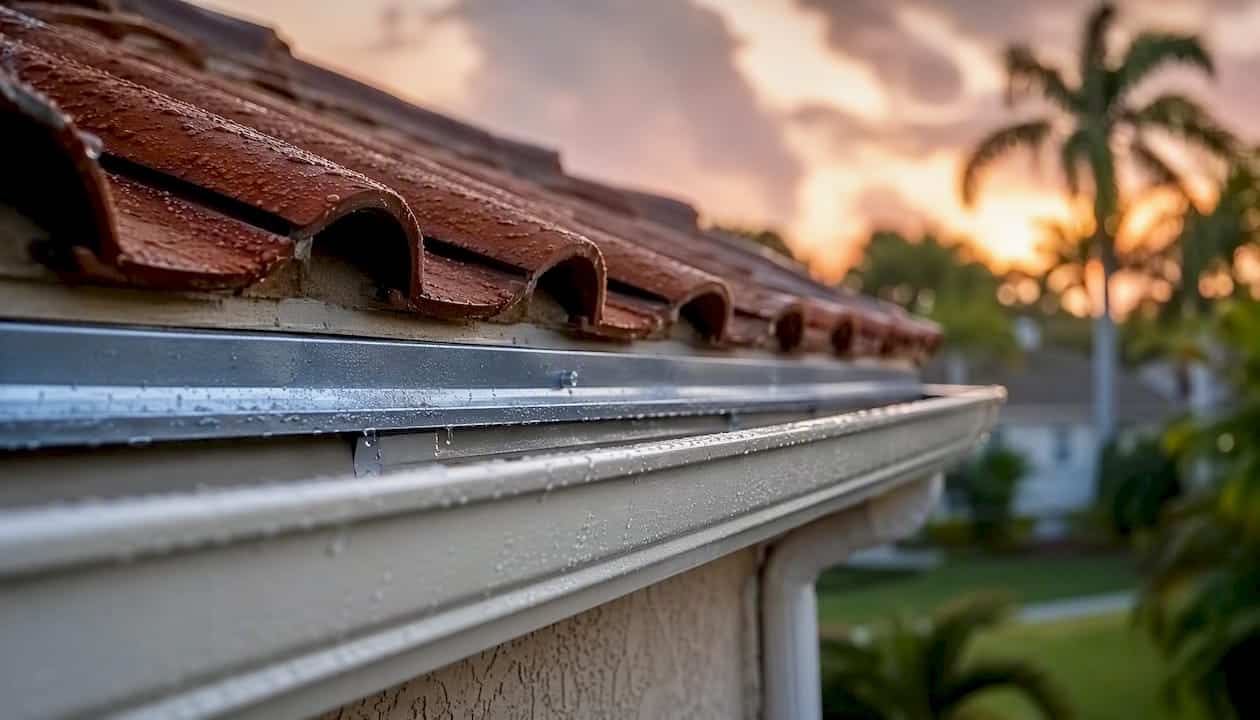
Where should downspouts discharge?
Into a place that can absorb water and is not right up against the house.
That guidance is consistent and practical. Turf areas, landscape beds, rain gardens, and similar pervious spots are usually the target. The point is to reduce runoff and keep water on site when possible, rather than creating a hard, fast flow path that causes erosion or sends water where you do not want it.
One mistake I see homeowners make conceptually is treating downspouts as the end of the system. They are not. They are the handoff. The real question is what happens next. If a downspout empties into a bare patch of sand beside the slab, expect splashback, washout, and an ugly groove after repeated storms. If it empties into a stable, planted area that can absorb the flow, the whole property usually handles rain better.
For homes with recurring wet spots, the smartest conversations focus less on the gutter profile and more on the exit path of the water.
What about gutter drainage for pool cages and screened lanais?
This is one of those Florida-specific questions that deserves more attention than it gets.
Pool decks, lanais, and screened enclosures create wonderful outdoor living space, but they also make drainage mistakes more noticeable. Roof runoff that pours toward a cage, splashes onto the deck, or erodes the edge of nearby beds turns an everyday summer storm into a cleanup problem. Guidance for Florida landscapes notes that runoff and drainage around outdoor living areas should be managed carefully so water does not create messy overflows or wear away the soil.
That is why gutter drainage for pool cages needs a little more thought than a standard side yard. It is not only about moving water off the roof. It is about protecting the space where people walk barefoot, move patio furniture, and spend time outside. A discharge point that works fine on the back corner of a yard may be a nuisance if it sends water across the pool screen perimeter or onto a paved section that already gets slick.
If your house backs up to a pool enclosure, the cleanest solution is usually the one that keeps the runoff directed into a planted or turfed area away from high-use surfaces. The exact layout varies from property to property, but the principle stays the same: get the water off the roof and into a place that can absorb it without making a mess of the entertaining area.
Do metal roofs need special gutter planning?
They need thoughtful gutter planning, just like any other roof.
Homeowners searching gutters for metal roofs Florida are usually worried about compatibility, appearance, and drainage performance. Those are sensible concerns. The answer is not that metal roofs require a completely different philosophy. The answer is that any roof and gutter combination should be planned so runoff is captured well and discharged into appropriate areas of the landscape.
The same core rules apply. Keep water away from the foundation. Aim for pervious areas that can absorb runoff. Maintain the system so debris does not block flow. If the roof sheds water quickly during heavy rain, that only makes proper placement and maintenance more important.
The appearance piece matters too, especially on homes where the roof is a strong design feature. Gutters should look like they belong there, not like an afterthought clipped to an otherwise cohesive exterior.
How do I choose gutter colors for Florida homes?
Start with the house, not the sample chip.
Many homeowners expect color to be a quick decision, but it often turns into a balancing act between roof color, fascia, trim, body color, and neighborhood standards. In Florida, bright light changes how exterior colors read. A color that looks subtle in the shade can appear much stronger in full sun. That is one reason gutter colors for Florida homes deserve a little patience.
There is also the practical side of neighborhood rules. Homeowners associations and architectural review committees often have authority over exterior appearance standards, which can include color and style requirements. At the same time, those standards must still comply with the building code and cannot be used to deny installations that otherwise conform. In plain English, it is wise to check the community rules before ordering a color, especially if your neighborhood reviews exterior changes.
Most of the time, the best gutter color is the one that visually settles into the house. Some homeowners want the gutter to blend into the fascia. Others prefer it to match trim accents. Both approaches can work. The mistake is choosing in isolation without looking at the roofline in full daylight.
Are gutter guards worth considering?
Sometimes, yes. Sometimes they are oversold.
The sensible reason to look at guards is maintenance reduction. Florida homes collect leaf litter, small debris, and roof grit, and that buildup contributes to drainage trouble if it is ignored. Routine upkeep is part of owning gutters here. Guards may help reduce how much debris enters the trough, but they do not eliminate maintenance altogether.
That is the point many homeowners miss when they start looking into products like gutter guards Mount Dora FL. The phrase sounds like a complete solution. In reality, guards are best viewed as one tool that may reduce cleaning frequency or improve performance in certain conditions. They are not a substitute for inspection, and they do not excuse a poor drainage layout.
If a house has recurring overflow, a blocked downspout, or discharge that is aimed at the wrong place, guards will not fix the underlying design problem. They may help with debris management, but water still has to go somewhere sensible.
Should I handle gutter cleaning myself, or hire a pro?
This is where judgment matters more than pride.
The question of DIY gutter cleaning or hire a pro often gets framed as a simple money decision. It is not. It is really a question about height, roof access, physical comfort on a ladder, and whether you can spot minor problems before they become bigger ones.
Florida guidance is clear that gutters and downspouts need maintenance because debris contributes to drainage issues. That means cleaning is not optional forever. It is routine upkeep. The real issue is who does it.
For a one-story home with easy access, some homeowners are comfortable doing basic cleaning and visual checks. For taller roofs, awkward slopes, or homes with pool decks, landscaping, or tight side yards below, many people are better off hiring someone equipped to do the job safely. The cost of a service visit is easier to swallow than the cost of a fall, and it is certainly easier than dealing with hidden overflow damage that nobody noticed from the ground.
A good rule of thumb is simple: if you are uneasy about the ladder before you start, that feeling is useful information.
What are the most common gutter myths Florida homeowners believe?
A few myths come up again and again, and they cause more trouble than they should.
- “If water is leaving the roof, the system is working.” Not necessarily. Water can leave the roof and still create pooling, erosion, or splashback if the downspouts send it to the wrong place.
- “Gutters are maintenance-free once installed.” They are not. Florida debris and frequent storms make cleaning and inspection part of normal upkeep.
- “A wet spot near the house is just a yard problem.” Sometimes it is actually a drainage problem that starts at the roofline.
- “Guards mean I never have to think about gutters again.” They may help with debris, but they do not replace periodic checks.
- “Color is purely cosmetic.” It affects curb appeal, and in some neighborhoods, exterior color choices may also be reviewed under association rules.
When people search gutter myths Florida homeowners, these are usually the misunderstandings sitting underneath the question. None of them are dramatic. They are just common, costly little assumptions.
How do I know if my current gutters need repair?
You do not need a dramatic failure to justify attention. Small issues often show up first as clues in the yard.
Maybe one bed keeps washing out while the others stay intact. Maybe mulch shifts after every storm. Maybe you notice a patch near the wall that stays damp longer than the rest of the property. Those are drainage signals, not just landscaping annoyances.
If you are searching gutter repair Hawthorne FL, chances are the first sign was not a gutter hanging loose like in a cartoon. It was probably repeated overflow, water landing where it should not, or a section that simply does not carry runoff cleanly anymore. The smartest move is to look at the whole path of water, from roof edge to discharge point, instead of focusing only on the visible gutter run.
Repair, in practical terms, is about restoring control. If the system no longer directs water away from the house and into absorbent areas, it needs attention.
How often should gutters be checked in this region?
The exact schedule varies by property, but regular checks matter because the weather does not wait for a convenient season. In a place with summer storms and tropical systems, it helps to think in rhythms rather than one annual date. Check before the wettest stretches, check after major storm periods, and check any time you notice odd runoff patterns in the yard.
Homeowners looking for a year-round gutter checklist Florida usually do best with something simple and repeatable:
- Look for visible debris in gutters and downspout openings.
- Watch where water exits during or just after rain.
- Check for pooling near the foundation or messy erosion in beds.
- Notice whether runoff is reaching turf or planted areas that can absorb it.
- Schedule cleaning or repair promptly if flow is blocked or misdirected.
That list is not fancy, but it catches most of the issues that matter.
What if my gutters seem fine, but the yard still has drainage trouble?
Then the problem may not be the gutter alone.
This is where homeowners can get frustrated. They clean the troughs, confirm the downspouts are open, and still end up with washouts or soggy spots. Usually that means the roof drainage system is doing part of its job but the discharge pattern still needs work. Water may be concentrated too heavily in one location, or it may be reaching a spot that cannot absorb it well.
Florida-friendly guidance emphasizes reducing runoff and keeping water on site through absorbent landscape areas whenever possible. That principle is useful because it shifts the conversation from “How do I get rid of this water?” to “Where can this water go without causing trouble?” The answer may be a lawn area, a bed, or another pervious zone that handles runoff better than the current outlet point.
It is a small mental shift, but it often leads to better decisions.
A final practical way to think about gutters
Around Gainesville, a good gutter system is not just attached to the roof. It is connected to the yard, the foundation, the outdoor living space, and the way rain moves through the property in real time.
That is why the best gutter decisions usually sound a little less like product talk and a little more like site planning. Where does the water leave the roof? Where does it land? Does that area absorb it, or does it wash out? Does the system protect the house and keep the landscape usable after a storm?
If you ask those questions first, the rest tends to fall into place, whether you are comparing gutter take a look guards Mount Dora FL, pricing gutter cleaning Dunnellon FL, exploring gutters for metal roofs Florida, or just trying to keep rain from turning the side yard into a muddy strip. The hardware matters, but the path of the water matters more.